
 New Products
 Earth-Friendly Products
 Biotium Choice Antibodies
 Special Offers
 Quick Order Tool


Content #1
Content #1
Content #1
Fremont, CA, February 21, 2024: Biotium, a leader in fluorescent dyes for life science research, announces the expansion of its NucSpot® Nuclear Stains lineup, offering unprecedented specificity and flexibility for nuclear counterstaining. NucSpot® Nuclear Stains are membrane-impermeant, targeting the nucleus selectively with minimal fluorescence until binding to DNA, enabling convenient no-wash nuclear staining. Unlike traditional options such as propidium iodide (PI), TO-PRO®, or TOTO®, NucSpot® achieves nuclear specificity in fixed and permeabilized cells without the need for RNase treatment.
Now with an extensive selection of 9 colors spanning the fluorescence spectrum from green to near-infrared (near-IR), NucSpot® Nuclear Stains provide greater panel flexibility, compatible with FITC, Cy®3, PE, Texas Red®, Cy®5, APC, Cy®5.5, and Cy®7 channels. Several options are non-toxic, suitable for cell cycle profiling by flow cytometry, and can be incubated in live cultures for multi-day imaging.
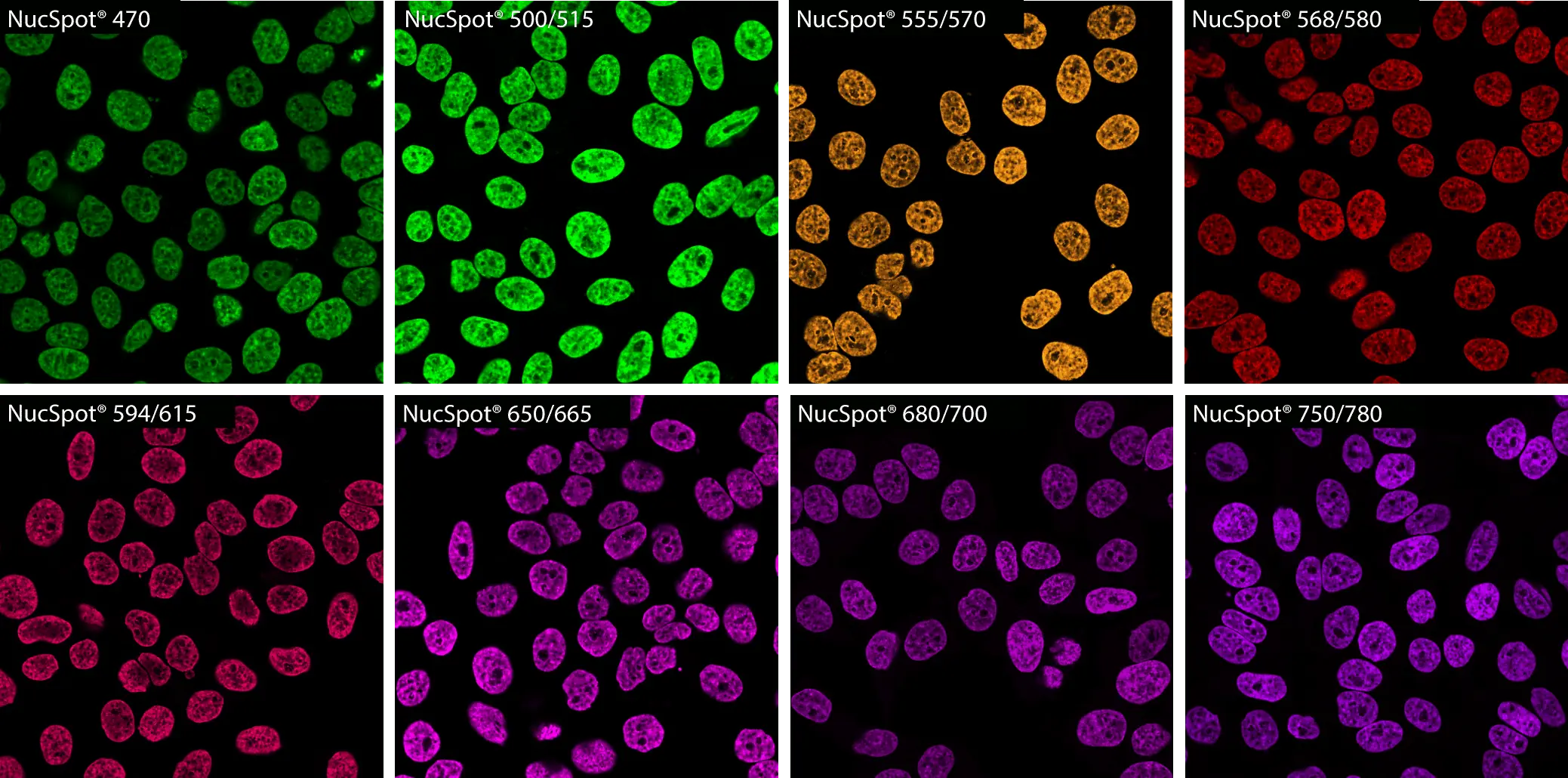
“These new additions to our cellular stains line provide a major improvement by broadly expanding scientists’ color choice for nuclear counterstaining. Plus, NucSpot® Nuclear Stains are much more photostable than existing cyanine-based nuclear stains, and there’s no need to treat with RNase for nuclear staining.” says Dr. Lori Roberts, Director of Bioscience at Biotium. “These novel dyes are products of our commitment to providing cutting-edge and convenient tools for cell biology research.”
For more information about NucSpot® Nuclear Stains, visit the product page.

Biotium is a leading life science reagent manufacturer and supplier devoted to providing high-quality and innovative fluorescent tools that fuel scientific discovery. Our collaborative team of experienced chemists and biologists, who are at the forefront of fluorescent dye design, apply chemistry-based principles toward producing solutions for unmet challenges in life science and medical research. Since its founding in 2001, Biotium has developed over 30 patented technologies that have been licensed out to leading life science technology companies worldwide.


Content #1
Content #1
Content #1
Content #2
Content #3