
 New Products
 Earth-Friendly Products
 Biotium Choice Antibodies
 Special Offers
 Quick Order Tool



 Powered by Bioz


Content #1
Content #1
Content #1
Highly sensitive, fluorescence-based quantitation of purified proteins.
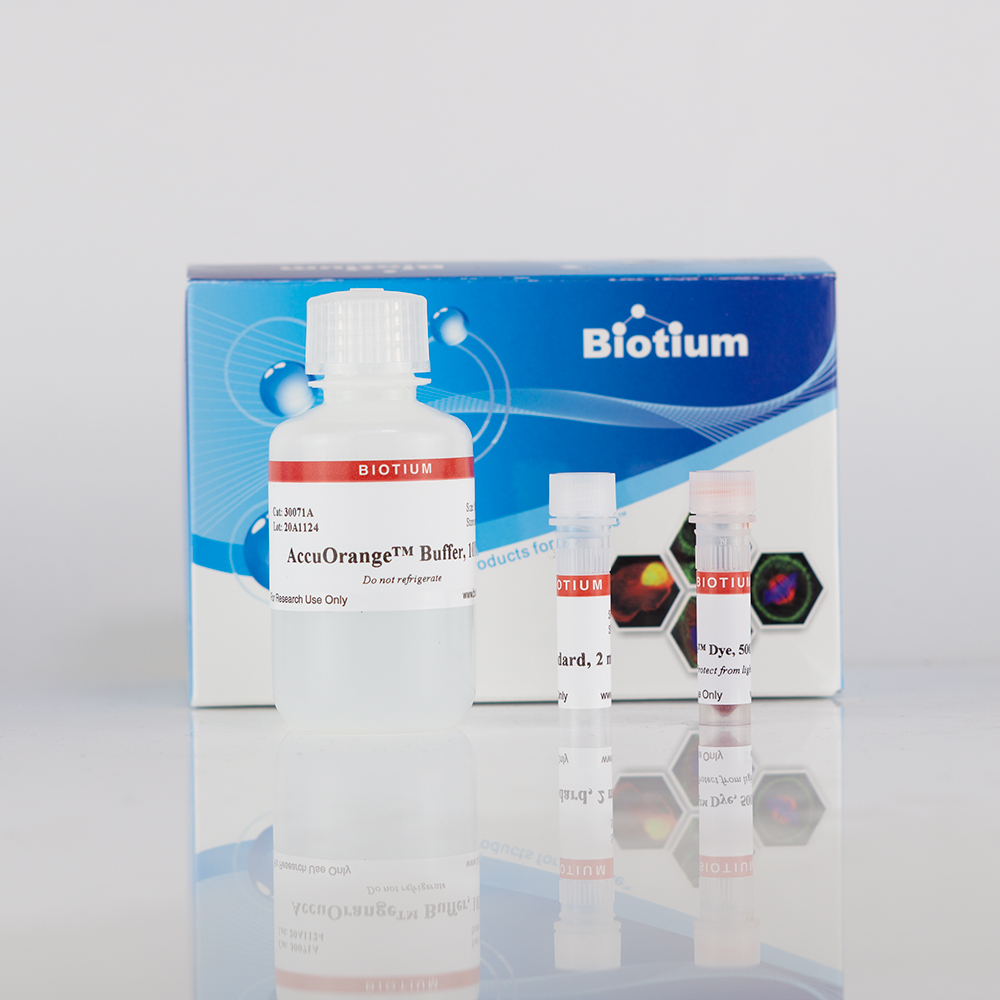
AccuOrange™ Protein Quantitation Kit is a highly sensitive fluorescence-based assay for quantifying purified protein samples in 96-well format.
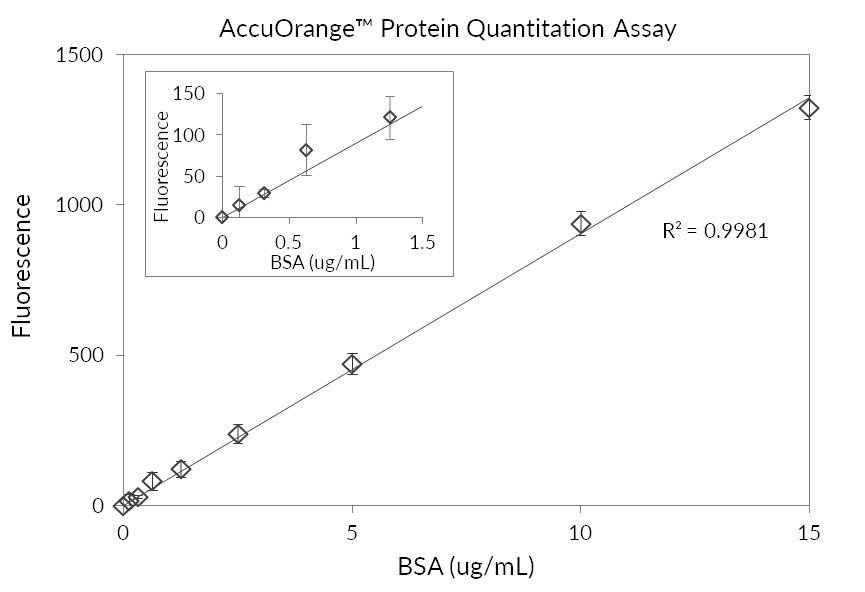
The detection range of the assay is 0.1-15 ug/mL protein. AccuOrange™ is much more sensitive than traditional protein quantitation assays such as BCA, Bradford and Lowry, and shows superior linearity and reproducibility compared to the NanoOrange® protein quantitation assay. The assay shows minimal variability between different proteins, and has stable fluorescence signal for up to 16 hours.
AccuOrange™ is recommended for quantifying purified protein or antibody samples. The tolerance of the AccuOrange™ assay to salts, buffers, detergents, and other chemicals is listed in the product protocol. The AccuOrange™ assay has low tolerance for non-ionic detergents, and is not recommended for use with cell lysates containing Triton™ X-100, sodium deoxycholate, CHAPs, or other non-ionic detergents. The assay can tolerate up to 0.01% SDS (final concentration in assay).
| Assay | Detection Range | Comments |
|---|---|---|
| AccuOrange™ | 0.1-15 ug/mL | Fluorescence-based (480/598 nm) Highly linear Signal stable for at least 16 hours Compatible with reducing agents Not compatible with detergents |
| NanoOrange® | 0.1-10 ug/mL | Fluorescence-based (470/570 nm) Non-linear Fluorescence stable for 6 hours Compatible with reducing agents Not compatible with detergents |
| Modified Lowry | 1-1500 ug/mL | Absorbance-based (750 nm) Non-linear Not compatible with reducing agents or detergents |
| BCA | 20-2000 ug/mL | Absorbance-based (562 nm) Highly linear Signal not stable over time Not compatible with reducing agents Compatible with detergents |
| Bradford (Coomassie®) | 50-500 ug/mL | Absorbance-based (595 nm) Signal not stable over time Non-linear Compatible with reducing agents Not compatible with detergents |
| Pierce® 660 nm | 50-2000 ug/mL | Absorbance-based (660 nm) Non-linear Compatible with reducing agents & detergents |
| A280 | 50-2000 ug/mL | Absorbance-based (280 nm) High protein-protein variability Contaminants and detergents can affect results |
Even though AccuOrange™ buffer does contain SDS, which is required for the dye to bind proteins, the assay is very sensitive to small changes in SDS concentration, and also cannot tolerate non-ionic detergents that form mixed micelles with SDS, like Triton®. Therefore we don't recommend using the kit for cell lysates or other samples with significant amounts of detergents.
Gels stained with One-Step Blue® can be dried just like gels stained with Coomassie. The stain will not interfere with the detection of radiolabeled proteins.
The AccuOrange™ assay is a fluorescent dye-based assay. The dye binds to proteins primarily through hydrophobic interactions. Proteins denature upon heating; the dye binds to the exposed hydrophobic pockets of the protein after cooling. The free AccuOrange™ dye is fluorogenic due to non-radioactive decay but becomes highly fluorescent due to the rigid conformation inside the pocket.
The AccuOrange™ assay more sensitive than traditional protein quantitation assays such as BCA, Bradford and Lowry, and shows superior linearity and reproducibility than the NanoOrange® protein quantitation assay (Thermo Fisher Sci.), but has low tolerance for detergents like SDS and Triton® X-100.


Content #1
Content #1
Content #1
Content #2
Content #3