New Products
 Earth-Friendly Products
 Biotium Choice Antibodies
 Special Offers
 Quick Order Tool


Content #1
Content #1
Content #1
Immunoglobulin G4-related disease (IgG4-RD) is a rare, chronic, immune-mediated disorder characterized by inflammation, fibrosis, and the accumulation of IgG4-producing plasma cells in affected tissues of nearly every organ. Its symptoms are highly variable and often mimic those of other inflammatory or autoimmune conditions, making IgG4-RD difficult to diagnose and treat before patients experience irreversible organ damage. Improving understanding of the biological mechanisms driving IgG4-RD, including the role of the gut microbiome, may help identify more reliable biomarkers and provide new insights into disease development and progression.
In a 2025 Discovery Science publication, Budzinski, L. et al. investigated whether the intestinal microbiome exhibits disease-specific characteristics that could aid in identifying IgG4-RD. The researchers analyzed stool samples from patients with IgG4-RD and healthy controls through both 16S rRNA gene sequencing to evaluate microbial composition and single-cell multiparameter flow cytometry to assess bacterial phenotypes. Biotium's Peanut Agglutinin-CF®488 (PNA), Concanavalin A-CF®680 (Con A), and Wheat Germ Agglutinin-CF®555 (WGA) were used to label bacterial surface glycans during multiparameter flow cytometric analysis. These phenotypic data were then integrated with machine-learning models to identify microbiota signatures associated with IgG4-RD. While sequencing identified changes in the types and diversity of bacteria present, phenotypic data revealed an increase in bacteria populations with low DNA and changes in surface glycan expression in samples from IgG4-RD patients.
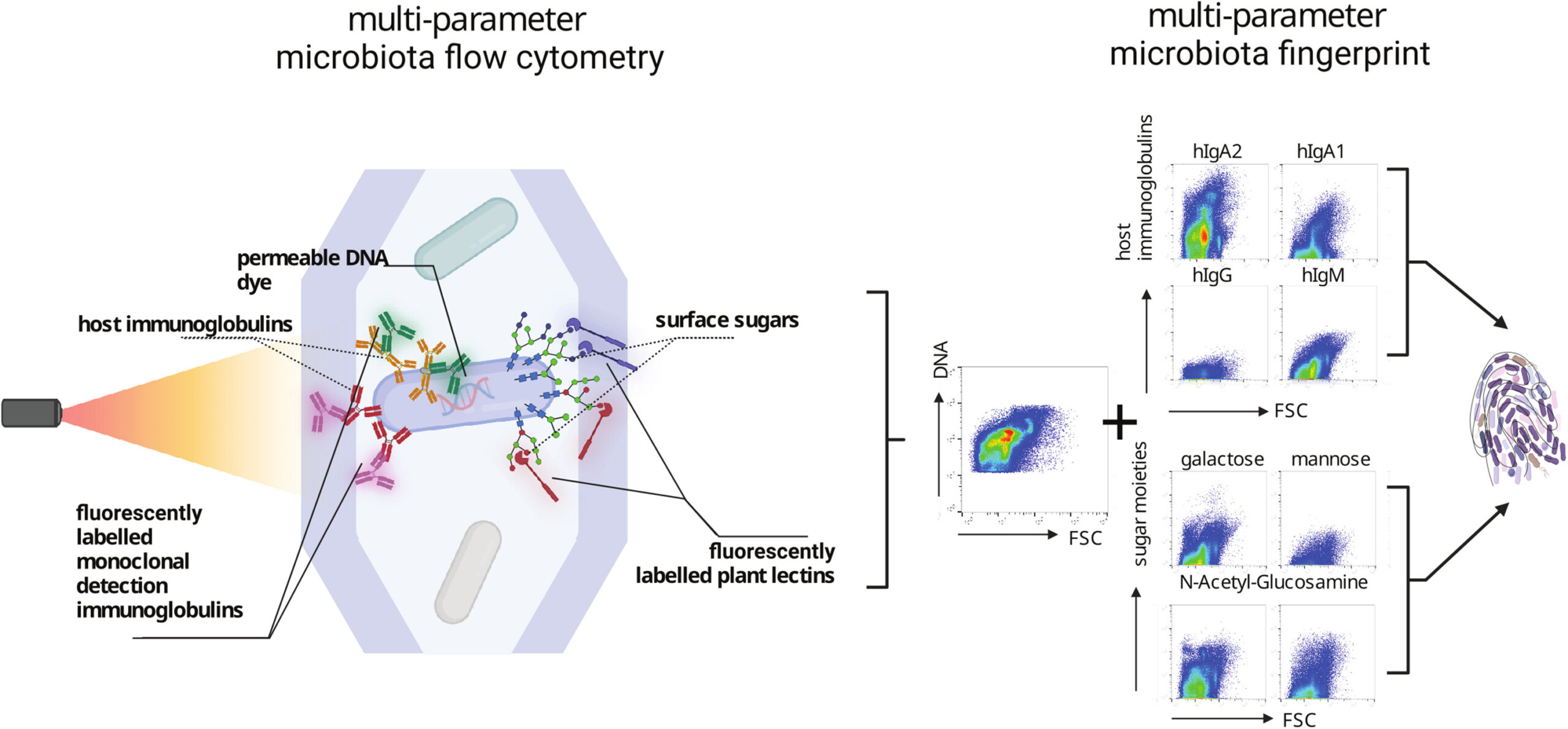
Fig. 2 Schematic of the single cell microbiota phenotyping approach. Bacterial cells are isolated from stool samples and fluorescently labelled for their DNA content, host immunoglobulin coating (panel 1) and the surface expression of the indicated sugar moieties (panel 2). The labelled cells are individually analysed by flow cytometry. The obtained staining patterns are computed in a microbiota fingerprint that represents the distribution of all cell events in 11-parameters. Adapted from Budzinski, L. et al. Reproduced under CC BY 4.0.
This study highlights the value of single-cell microbial analysis for studying complex immune-mediated diseases. The sensitive, multiplex analysis of bacterial surface glycans at the single-cell level helped reveal functional microbial signatures that were not evident through taxonomic analysis alone. As researchers continue investigating the interplay between the microbiome and immune-mediated diseases, Biotium's CF® Dye-conjugated lectins and other fluorescent reagents provide the high-performance tools needed to generate reproducible, high-resolution phenotypic data that can drive biomarker discovery and deepen our understanding of host-microbe interactions.
View Biotium's full catalog of CF® Dye-conjugated lectins to support your next microbiome and immunology research project. Also browse our unique stains for microbiology research, including dead-cell specific stains, gram stains, and organelle stains.
Full Citation
Budzinski L, Beenken AE, Sempert T, Kang GU, Abbas A, Lietz L, Maier R, Mashreghi MF, Chang HD, Alexander T. IgG4-related disease has a specific intestinal microbiota signature. EBioMedicine. 2026 Jul;129:106326. doi: 10.1016/j.ebiom.2026.106326. Epub 2026 Jun 11. PMID: 42276012; PMCID: PMC13276518.