New Products
 Earth-Friendly Products
 Biotium Choice Antibodies
 Special Offers
 Quick Order Tool



Content #1
Content #1
Content #1
A red derivative of BCIP that produces a red (λmax 565 nm) colored precipitate instead of the dark blue precipitate of BCIP. BCIP and derivatives are the most widely used chromogenic phosphatase substrate for the detection of alkaline phosphatase labeled proteins in a variety of applications.
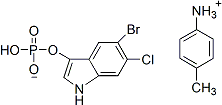
BCIP Red (5-Bromo-6-chloro-3-indoxyl phosphate, p-toluidine salt) is a derivative of BCIP. While BCIP yields a dark blue precipitating product, BCIP Red produces a red (λmax 565 nm) colored precipitate. BCIP and the derivatives are the most widely used chromogenic phosphatase substrate. They are often used with the oxidant NBT (nitro blue tetrazolium chloride), which facilitates the precipitation, to detect alkaline phosphatase activity and alkaline phosphatase labeled proteins in a variety of applications, such as immunohistochemistry, westerns, and in situ hybridization.
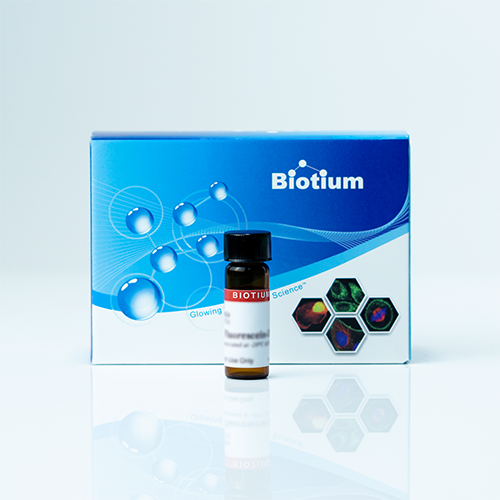
This kit contains 100 mg each of BCIP Red (10004) and the oxidant NBT (10008). We also offer Alkaline Phosphatase Conjugated Antibodies.
The original BCIP forms a dark blue (λmax 615 nm) precipitate and is available in two different salt formulations; BCIP, toluidine salt is soluble in DMF while BCIP, sodium salt is soluble in water. We also offer a Pink BCIP derivative, which produces a pink colored (λmax 540 nm) precipitate. BCIP Red produces a red colored (λmax 565 nm) precipitate. Please see our BCIP Kits that are paired with NBT (nitro blue tetrazolium chloride) for user convenience.
Chemical Structure BCIP Red:
Even though AccuOrange™ buffer does contain SDS, which is required for the dye to bind proteins, the assay is very sensitive to small changes in SDS concentration, and also cannot tolerate non-ionic detergents that form mixed micelles with SDS, like Triton®. Therefore we don't recommend using the kit for cell lysates or other samples with significant amounts of detergents.
Gels stained with One-Step Blue® can be dried just like gels stained with Coomassie. The stain will not interfere with the detection of radiolabeled proteins.
The AccuOrange™ assay is a fluorescent dye-based assay. The dye binds to proteins primarily through hydrophobic interactions. Proteins denature upon heating; the dye binds to the exposed hydrophobic pockets of the protein after cooling. The free AccuOrange™ dye is fluorogenic due to non-radioactive decay but becomes highly fluorescent due to the rigid conformation inside the pocket.
The AccuOrange™ assay more sensitive than traditional protein quantitation assays such as BCA, Bradford and Lowry, and shows superior linearity and reproducibility than the NanoOrange® protein quantitation assay (Thermo Fisher Sci.), but has low tolerance for detergents like SDS and Triton® X-100.