
 New Products
 Earth-Friendly Products
 Biotium Choice Antibodies
 Special Offers
 Quick Order Tool





Content #1
Content #1
Content #1
For simple, optimized tyramide amplification of immunostaining in cells or tissue sections. No need to add hydrogen peroxide before use.

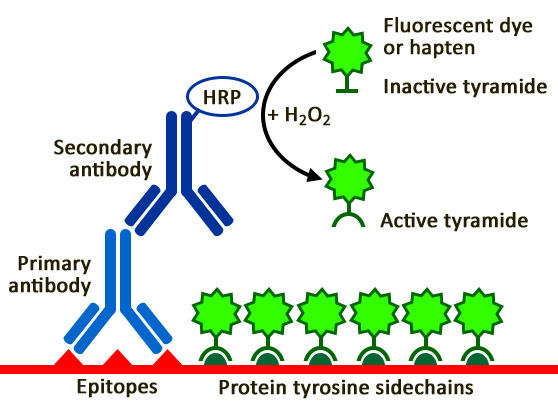
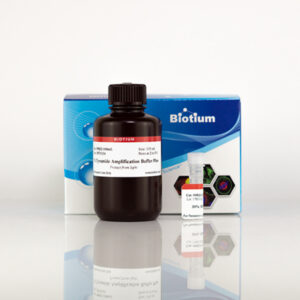
Ready-to-Use Tyramide Amplification Buffer was designed for simple, optimized tyramide amplification of immunostaining in cells or tissue sections. There is no need to add hydrogen peroxide before use.
Features:
Please note that Biotium has released a new, improved buffer for tyramide signal amplification. The Tyramide Amplification Buffer Plus (22029) provides significantly improved brightness, specificity, and sensitivity over this original buffer.
Ready-to-Use Tyramide Amplification Buffer was designed for simple, optimized signal amplification of immunostaining in cells or tissue sections. Simply mix your tyramide compound with the buffer to make a working solution for signal amplification. Although specifically optimized for our CF® Dye-, Biotin XX-, and DNP-tyramide products, Ready-to-Use Tyramide Amplification Buffer is also compatible with tyramide probes from other manufacturers.
Also learn about TyraMax™ Amplification Dyes and Kits, Biotium's next generation tyramide dyes that offer brighter signal compared to the original CF® Dye Tyramides, and have advantages in brightness, photostability, and working solution stability compared to other TSA dyes. We also offer CF® Dye Tyramide Amplification Kits. Learn more about Tyramide Signal Amplification.
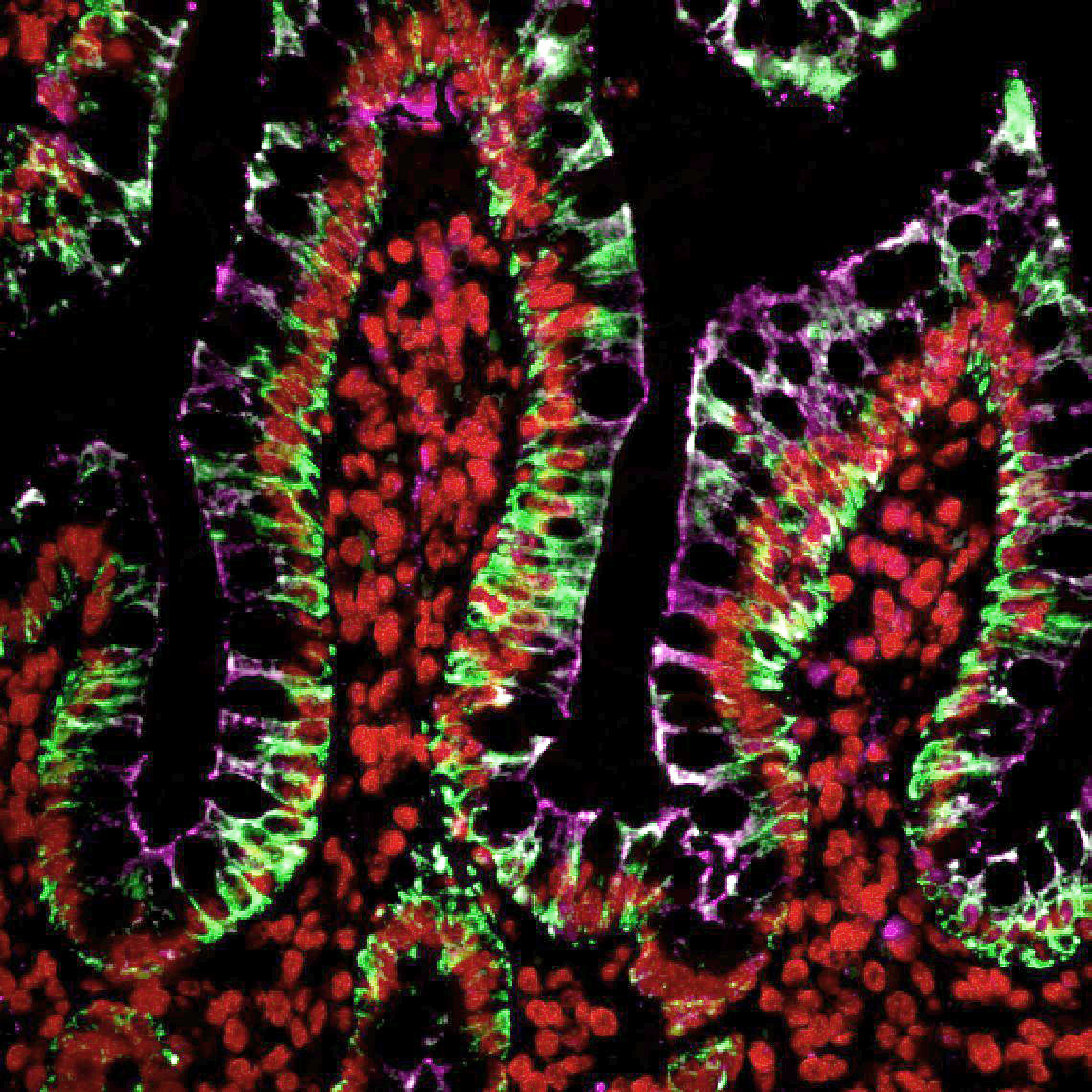
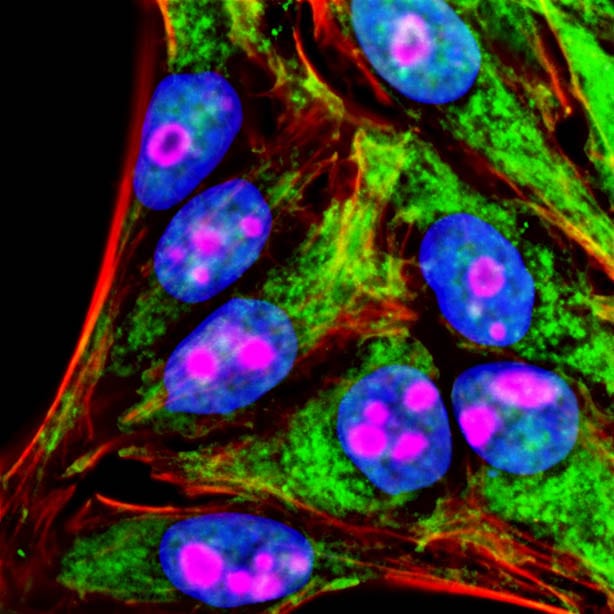
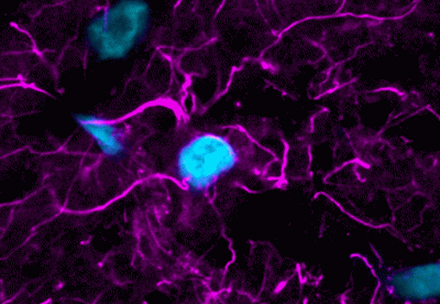
Our Tyramide Amplification Kits have been demonstrated to be robust and versatile for multi-color fluorescence imaging, compatible with dye-labeled antibodies and various cell staining methods (see Figure 1).
To use a Tyramide Amplification Kit in addition to one or more dye-labeled antibodies, follow the kit protocol to fix and block samples; label with primary antibodies; then detect primary antibodies using secondary antibodies. Dye labeled secondary antibodies can be co-incubated with the HRP-conjugated secondary or HRP-streptavidin from the tyramide kit. After washing, perform the CF® Dye tyramide reaction according to the kit protocol. The tyramide reaction does not interfere with the binding of dye-labeled antibodies or other fluorescent staining reagents.
Performing multi-color detection with more than one dye tyramide on the same sample requires sequential tyramide staining reactions, followed by HRP inactivation or antibody stripping between each step. See our tech tip:
Multi-Color Fluorescence Imaging Using Biotium's Tyramide Amplification Kits
We do not have any firsthand information about whether increasing tyramide incubation time will improve staining for thicker sections. We have tested tyramide on slide-mounted cryosections that are 10 um thick. Published protocols for 40 um floating sections recommend performing the tyramide development step for 15 minutes at room temperature.
If you are using free-floating sections, generally all incubation steps (permeabilization, antibody incubation, and washing) are longer than for sections on slides. The tyramides are small molecules and should penetrate tissue more rapidly than antibody conjugates, but you may wish to test a longer incubation time to allow the buffer to penetrate the tissue.
Biotium developed TyraMax™ Amplification Dyes as high-performance TSA dyes, offering brighter, more photostable signals than Aluora® and Opal® reagents. They also remain stable in amplification buffer for up to 24 hours, facilitating automated staining workflows. TyraMax™ Dyes are offered as standalone dye solutions, as 3-color or 5-color dye sets plus DAPI counterstain, and in a sampler for custom panel optimization. See below for alternatives to specific Aluora® and Opal® reagents. Learn more about our reagents for tyramide signal amplification (TSA).
| Dye | Abs/Em (nm) | Laser Line | Detection channel | Dye Features | Size | Catalog No. |
|---|---|---|---|---|---|---|
| TyraMax™ 410/450 | 408/452 | 405 nm | DAPI/ Alexa Fluor® 405 | Unique tyramide color, spectrally similar to Alexa Fluor® 405 | 20 uL | 96134-20UL |
| 100 uL | 96134-100UL | |||||
| TyraMax™ 430/500 | 421/497 | 405 nm | FITC | Brighter than Aluora® 430 and Opal® 480 | 20 uL | 96135-20UL |
| 100 uL | 96135-100UL | |||||
| TyraMax™ 400/550 | 394/547 | 405 nm | FITC | Unique tyramide color, spectrally similar to Pacific Orange® | 20 uL | 96136-20UL |
| 100 uL | 96136-100UL | |||||
| TyraMax™ 490/520 | 497/518 | 488 nm | FITC | Brighter than Opal® 520, replacement for Aluora® 488 | 20 uL | 96137-20UL |
| 100 uL | 96137-100UL | |||||
| TyraMax™ 555/565 | 594/569 | 555 nm or 561 nm | TRITC | Brighter than Opal® 570, replacement for Aluora® 555 | 20 uL | 96138-20UL |
| 100 uL | 96138-100UL | |||||
| TyraMax™ 560/580 | 562/584 | 555 nm or 561 nm | TRITC | Alternative to Aluora® 555, Opal® 570 with superior photostability | 20 uL | 96139-20UL |
| 100 uL | 96139-100UL | |||||
| TyraMax™ 630/650 | 631/650 | 633 nm or 640 nm | Cy®5 | Bright and photostable alternative to Aluora® 647, Opal® 650 | 20 uL | 96140-20UL |
| 100 uL | 96140-100UL | |||||
| TyraMax™ 647/670 | 650/670 | 633 nm or 640 nm | Cy®5 | Brighter than Opal® 650, replacement for Aluora® 647 | 20 uL | 96141-20UL |
| 100 uL | 96141-100UL | |||||
| TyraMax™ 660/680 | 663/683 | 633 nm or 640 nm | Alexa Fluor® 680 | Unique tyramide color, spectrally similar to Alexa Fluor® 660. Brighter and more photostable Opal® 690 when excited at 640 nm | 20 uL | 96142-20UL |
| 100 uL | 96142-100UL | |||||
| TyraMax™ 680/700 | 680/701 | 685 nm (detectable with 640 nm excitation) | Alexa Fluor® 680 | Brighter and more photostable than Opal® 690 when excited at 685 nm | 20 uL | 96143-20UL |
| 100 uL | 96143-100UL | |||||
| TyraMax™ 710/740 | 711/736 | 685 nm | Alexa Fluor® 700 | Brighter and more photostable than Aluora® 700 | 20 uL | 96144-20UL |
| 100 uL | 96144-100UL | |||||
| TyraMax™ 740/770 | 742/768 | 730 nm | Alexa Fluor® 750 | Single-step detection, unlike Opal® 780. Stable in amplification buffer for up to 24 hours, unlike Aluora® 750 | 20 uL | 96145-20UL |
| 100 uL | 96145-100UL |
| Component # | Component Name | Size |
|---|---|---|
| 96137-100UL | TyraMax™ 490/520 Amplification Dye, 100X, 100 uL | For 100 samples using 100 uL staining volume |
| 96139-100UL | TyraMax™ 560/580 Amplification Dye, 100X, 100 uL | |
| 96140-100UL | TyraMax™ 630/650 Amplification Dye, 100X, 100 uL | |
| 99897-50UL | DAPI, 1000X, 50 uL |
| Component # | Component Name | Size |
|---|---|---|
| 96137-100UL | TyraMax™ 490/520 Amplification Dye, 100X, 100 uL | For 100 samples using 100 uL staining volume |
| 96139-100UL | TyraMax™ 560/580 Amplification Dye, 100X, 100 uL | |
| 96140-100UL | TyraMax™ 630/650 Amplification Dye, 100X, 100 uL | |
| 96143-100UL | TyraMax™ 680/700 Amplification Dye, 100X, 100 uL | |
| 96145-100UL | TyraMax™ 740/770 Amplification Dye, 100X, 100 uL | |
| 99897-50UL | DAPI, 1000X, 50 uL |
| Component # | Component Name | Size |
|---|---|---|
| 96134-20UL | TyraMax™ 410/450 | For 20 samples per vial using 100 uL staining volume |
| 96135-20UL | TyraMax™ 430/500 | |
| 96136-20UL | TyraMax™ 400/550 | |
| 96137-20UL | TyraMax™ 490/520 | |
| 96138-20UL | TyraMax™ 555/565 | |
| 96139-20UL | TyraMax™ 560/580 | |
| 96140-20UL | TyraMax™ 630/650 | |
| 96141-20UL | TyraMax™ 647/670 | |
| 96142-20UL | TyraMax™ 660/680 | |
| 96143-20UL | TyraMax™ 680/700 | |
| 96144-20UL | TyraMax™ 710/740 | |
| 96145-20UL | TyraMax™ 740/770 |
Aluora is a registered trademark of Thermo Fisher Scientific; Opal is a registered trademark of Akoya Biosciences.


Content #1
Content #1
Content #1
Content #2
Content #3