New Products
 Earth-Friendly Products
 Biotium Choice Antibodies
 Special Offers
 Quick Order Tool


 Powered by Bioz


Content #1
Content #1
Content #1
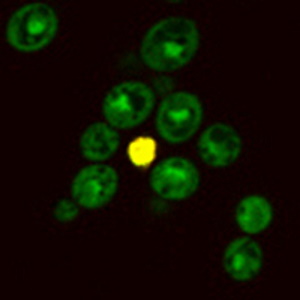
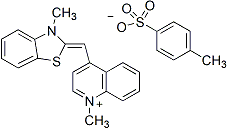
Thiazole orange (TO) is commonly used in reticulocyte analysis to stain residual RNA of blood cells, to stain DNA in agarose gels and capillary electrophoresis. Thiazole Orange stains the yeast nucleus, and is also able to stain bacteria and mammalian cells.
Thiazole orange (TO) is commonly used in reticulocyte analysis to stain residual RNA of blood cells1, to stain DNA in agarose gels2 and capillary electrophoresis3.
In live yeast, TO shows both nuclear concentration and cytoplasmic signal; after fixation the staining becomes completely cytoplasmic. In live mammalian cells, thiazole orange initially stains mitochondria and then redistributes to the nucleus and cytoplasm. Thiazole orange can also stain live bacteria (gram-positive and gram-negative). See our Cellular Stains Table for more information on how our dyes stain various organisms.
Product Features:
1. Cytometry 7, 508-517 (1986).
2. Nucleic Acids Res. 19, 327-333 (1990).
3. Chem. 66, 1941-1948 (1994).
1. Cytometry 7, 508-517 (1986).
2. Nucleic Acids Res. 19, 327-333 (1990).
3. Chem. 66, 1941-1948 (1994).
To date, we have not identified a fluorescent cellular stain that will detect bacteria but not mammalian cells with high specificity, or vice versa. While some mammalian cell stains show weak staining of bacteria, they usually do show some signal, and will frequently stain dead bacteria more intensely than live bacteria.
We offer a selection of antibodies for specific bacterial antigens, which potentially have applications for differential staining of bacteria vs. mammalian cells, but we have not validated them in co-culture models.
Also see our Viability PCR Technology Page to learn about how PMA dye can be used for highly specific detection of microbial cell viability in complex samples.
CellBrite® and MemBrite® Stains were originally developed for staining mammalian cells in culture, but some of the stains also have been validated for other organisms and applications. For dyes to stain yeast or bacteria membranes, see Cellular Stains in Different Organisms. For information on staining other organisms or cell types, please see our Tech Tip: Researching Applications for Membrane Dyes.
The CellBrite® Cytoplasmic Membrane Dyes do not stain bacteria. The reactive CellBrite® Fix dyes stain both gram-positive and gram-negative bacteria, while the MemBrite® Fix dyes stain only gram-positive bacteria. However we have not tested these dyes for cell division tracking in bacteria.
There is literature describing the use of CFSE to track bacterial cell division, the ViaFluor® SE cell proliferation dyes are likely to work in a similar manner, but we have not tested this.
See our Cellular Stains Table for a comprehensive list of cellular stains with their ability to stain various cell types.