Menu
biotium logo
Antibody Finder
Menu
Hero Image

ViaPlex™ Cell Barcoding Kits

Streamline your flow cytometry analysis by combining up to 15 samples in one tube.

Combine 15 Samples in One Tube

Streamline your analysis by combining up to 15 samples in a single staining reaction.

Save Time & Reagents

Analyze samples in a single run and use significantly less reagents.

Improve Sample Consistency

Combining samples removes technical variability between staining reactions.

What is Fluorescent Cell Barcoding for Flow Cytometry?

Fluorescent cell barcoding (FCB) is a multiplexing technique that labels cell samples with unique fluorescent signatures, enabling them to be pooled and digitally deconvoluted in downstream analysis. Pooled samples can be treated collectively in a single tube with antibodies, viability dyes, or other stains and analyzed in a single run, ensuring uniform labeling across all samples and eliminating inter-sample technical variability. This approach significantly reduces both the time and reagent costs associated with processing large numbers of samples.

Several methods for FCB have been developed for flow cytometry, this includes the use of amine-reactive NHS ester dyes or fluorescent antibody conjugates. NHS ester dyes covalently label cells at varying concentrations, allowing multiple unique barcodes to be generated from a small number of dyes. However, traditional NHS ester dyes are typically only compatible with fixed cells and intracellular staining. Fluorescent antibody conjugates can be used for both live and fixed cell barcoding, but this approach can suffer from non-specific binding, epitope competition, and antibody detachment and re-attachment to neighboring cells.
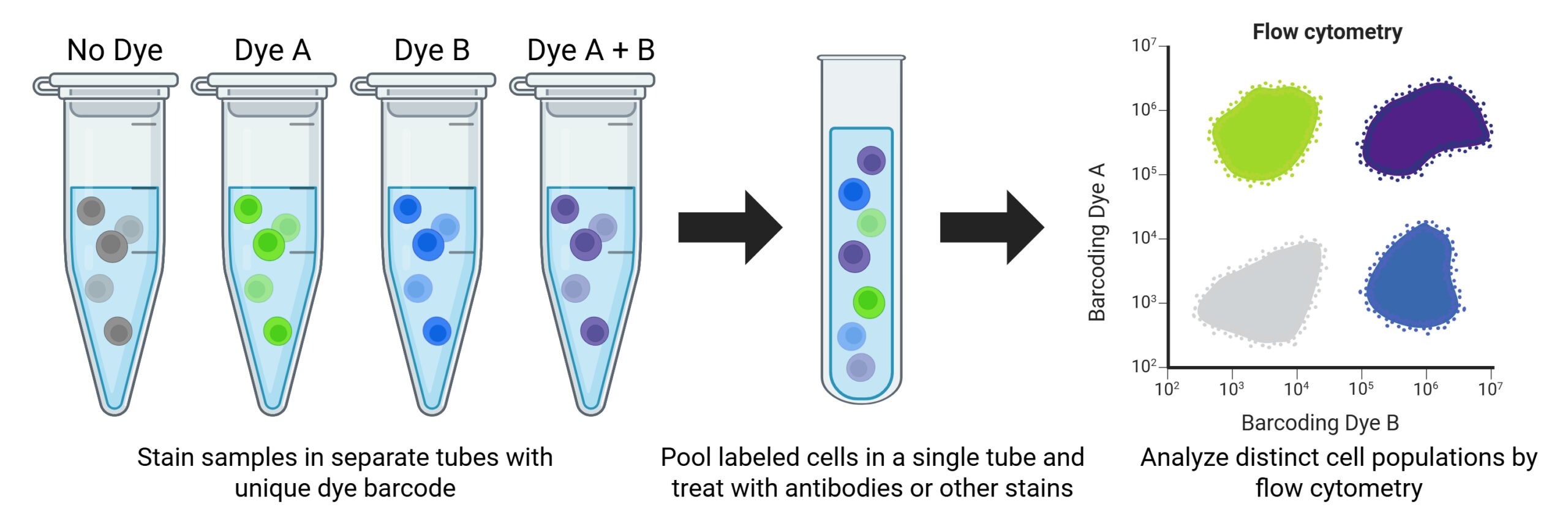
General concept of fluorescent cell barcoding using dyes. Created in https://BioRender.com.

Advantages of Fluorescent Cell Barcoding

Traditional StainingFluorescent Cell Barcoding
Each sample run separatelyAll samples analyzed in a single run
Variability between samplesTechnical variability minimized
More reagent consumptionSignificantly fewer reagents needed
Longer acquisition timeSignificantly faster data collection

Flexible Live Cell Barcoding with ViaPlex™

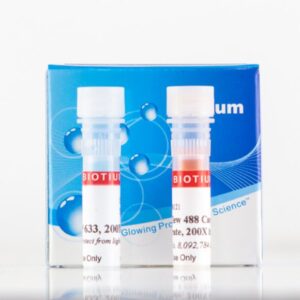
The ViaPlex™ Cell Barcoding Kit enables convenient and flexible cell barcoding of up to 15 cell populations in a single tube, saving time and reagents. Cells are labeled using covalently bound fluorescent dyes with up to three concentrations per dye.

Unlike traditional NHS-ester labeling, such as the BD Phosflow™ Violet Kit, ViaPlex™ barcoding is compatible with surface and intracellular antibody staining workflows, and barcoding can be performed either before or after cell treatment to accommodate a wide range of experimental designs. ViaPlex™ labeling does not require fixation or permeabilization, enabling assays on live cells. However, the covalent dye labeling also allows barcoded cells to be fixed and permeabilized for intracellular detection.
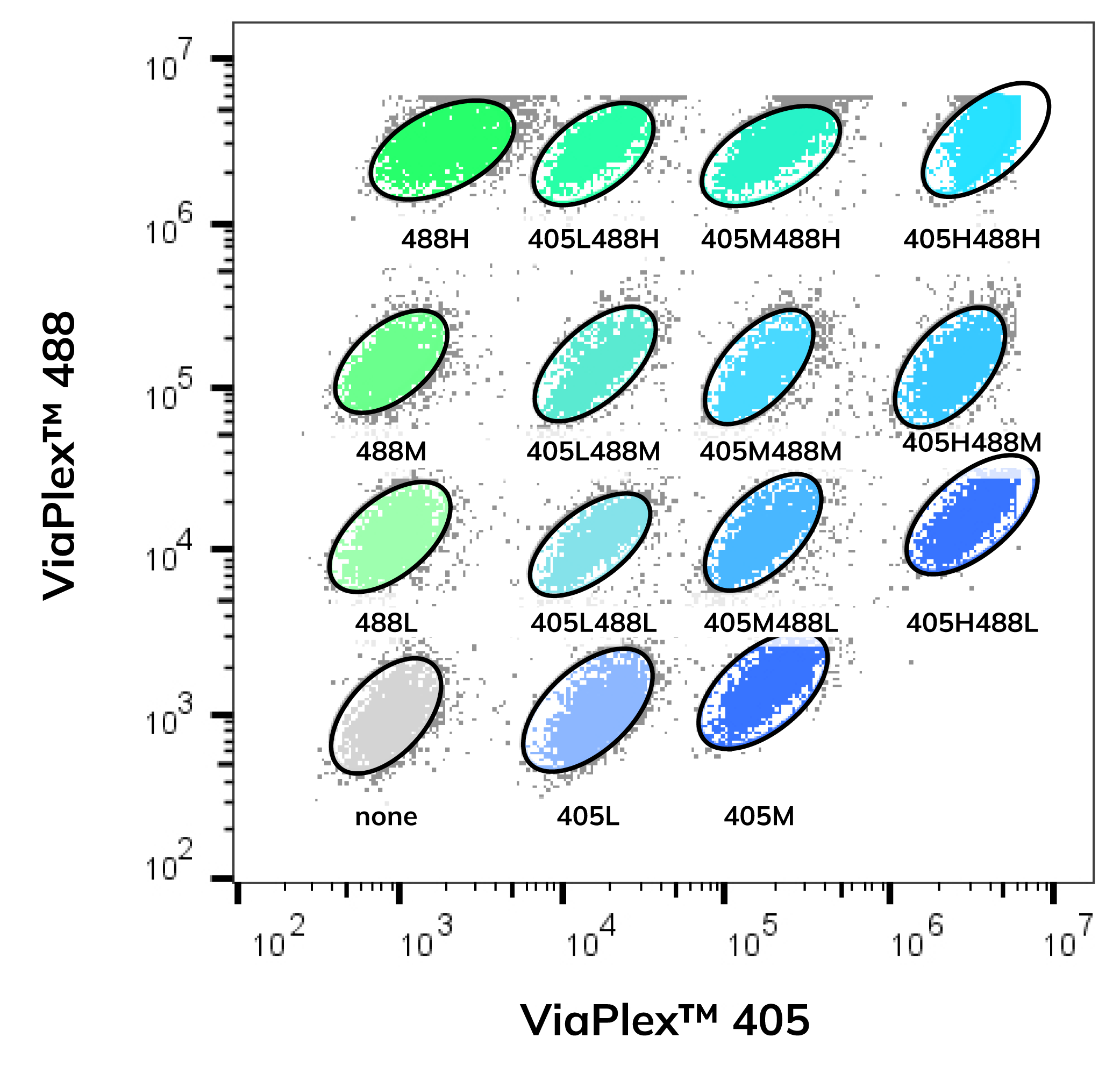
ViaPlex™ 2-Color Cell Barcoding Kit (405 & 488). 15 separate Jurkat cell populations were stained with 15 barcode dye combinations, combined into a single tube,... See More

ViaPlex™ Features

  • Saves time and reagent cost
  • Multiplex up to 15 samples in one staining reaction; optional 16th barcode via compensation
  • Compatible with surface and/or intracellular staining
  • Works with live cells, fixation optional after barcoding
  • Covalent dyes stably label cells for clean sample separation
  • Uses Pacific Blue® and FITC channels
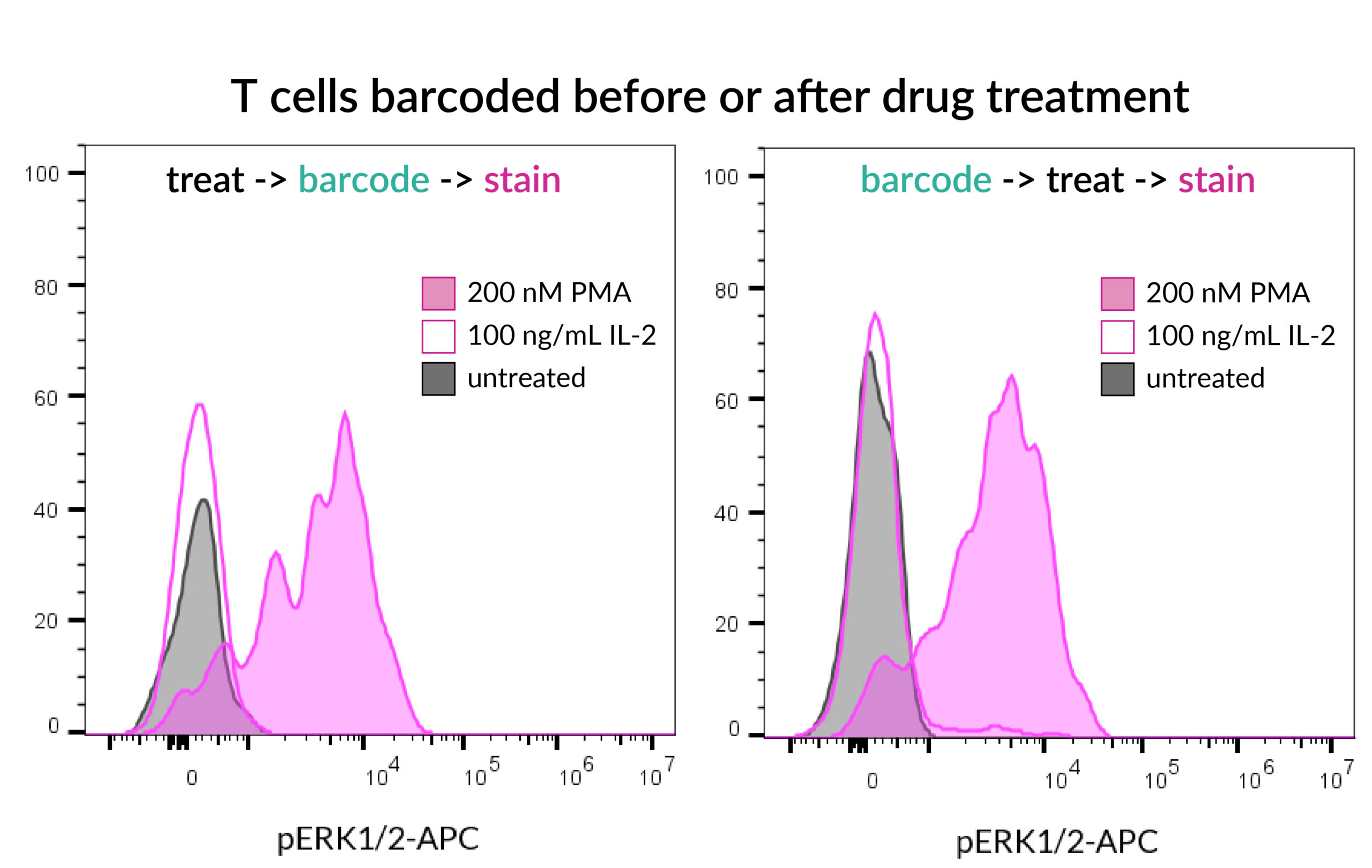
Barcoding can be done before or after cell treatment. PBMCs were barcoded with the ViaPlex™ 2-Color Cell Barcoding Kit (405 & 488) either before or after treatm... See More

Advantages of ViaPlex™ Cell Barcoding

Traditional NHS-ester barcodingViaPlex™ Cell Barcoding
Does not work with live cells, requires fixation before barcodingWorks with live cells, fixation optional after barcoding
Not suitable for surface staining, intracellular onlyCan be used for both surface and intracellular staining
Cell treatment must be done before barcodingCell treatment can be done before or after barcoding

View Product Page

ViaPlex™ Barcoding Workflow Overview

Prepare Cells

Obtain up to 15 distinct cell populations. Cells can be treated as desired (e.g., add any drugs or cytokines for the desired amount of time).

Setup the Barcoding Matrix

Using just two ViaPlex™ Dyes at three intensity levels (negative, mid, high), you can generate up to 15 unique combinations. An optional 16th barcode can be added but will require compensation during analysis. Each dye combination is then used to stain each individual cell population.

Stain Cells with Dye Barcodes

Stain each cell population with a unique dye barcode prepared from the barcode matrix, then pool samples in a single tube for downstream staining and analysis.

Aliquot Barcoded Cells for Staining

Aliquot the combined barcoded cells into separate tubes for staining your targets of interest and appropriate controls. Use stains that are complementary to ViaPlex™ 405 and ViaPlex™ 488.

Analyze by Flow Cytometry

Analyze the sample by setting gates on each of the 15 individual barcoded populations. An optional 16th barcode can be added if compensation is performed. Detect your antibodies or other stains of interest in the appropriate channels.

Overview of ViaPlex™ Barcoding Workflow
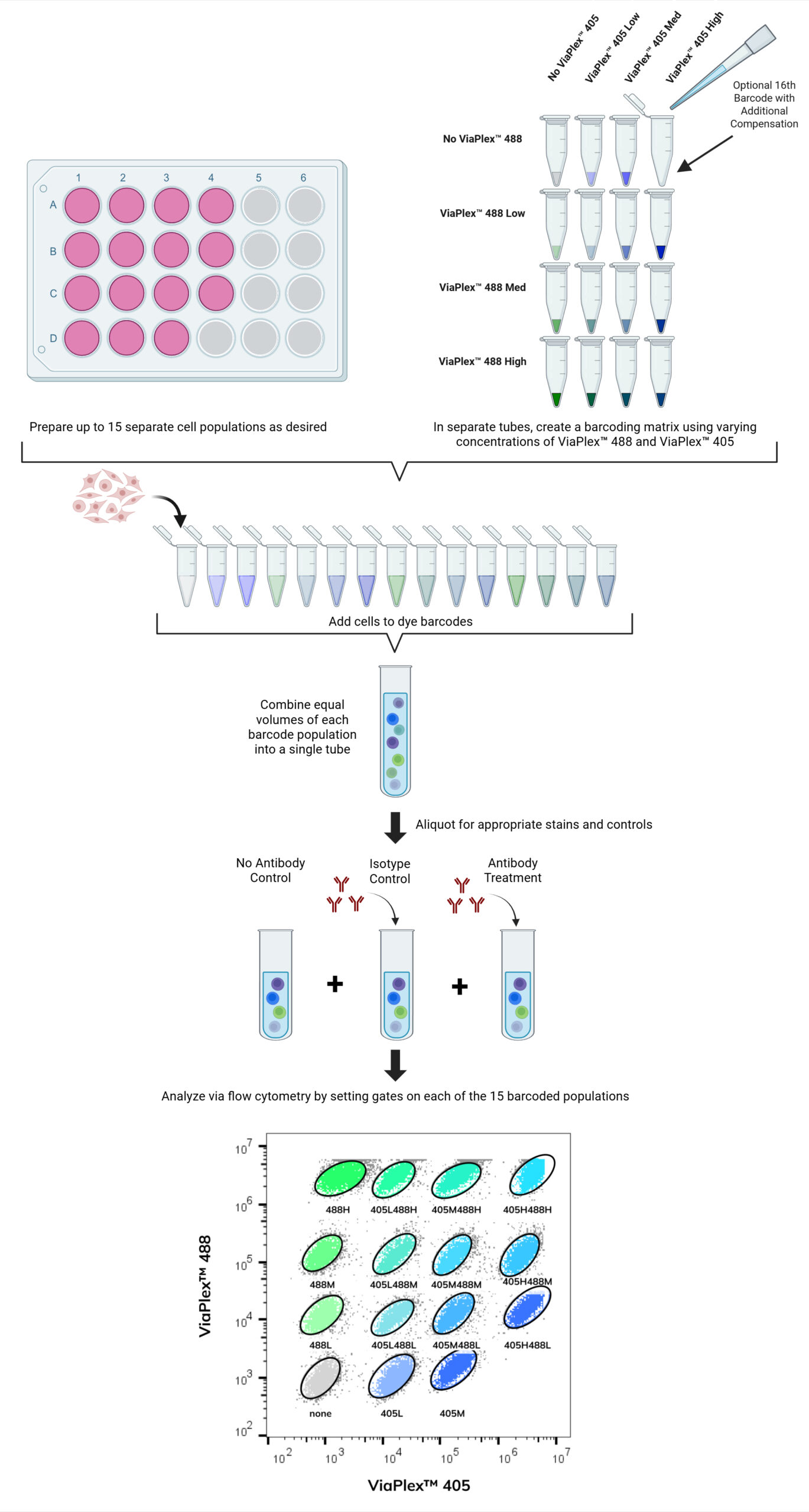
Overview of ViaPlex™ barcoding workflow. Created in https://BioRender.com.


Phosflow is a trademark of BD Biosciences.
FAQs

Most of our products are stable at room temperature for many days, so in all likelihood the product will still work just fine. To be on the safe side, we recommend performing a small scale positive control experiment to confirm that the product still works for your application before processing a large number of samples or precious samples.

One exception that we are aware of is GelGreen®, which is more sensitive to light exposure than most of our other fluorescent dyes. If GelGreen® is exposed to ambient light for a prolonged period of time (days to weeks), its color will change from dark orange to brick red. If this occurs, the GelGreen will no longer work for gel staining.


Bioscience kits
The guaranteed shelf life from date of receipt for bioscience kits is listed on the product information sheet. Some kits have an expiration date printed on the kit box label, this is the guaranteed shelf life date calculated from the day that the product shipped from our facility. Kits often are functional for significantly longer than the guaranteed shelf life. If you have an older kit in storage that you wish to use, we recommend performing a small scale positive control experiment to confirm that the kit still works for your application before processing a large number of samples or precious samples.

Antibodies and other conjugates
The guaranteed shelf life from date of receipt for antibodies and conjugates is listed on the datasheet sheet which can be downloaded on the product page. Antibodies and other conjugates often are functional for significantly longer than the guaranteed shelf life. If you have an older conjugate in storage that you wish to use, we recommend performing a small scale positive control experiment to confirm that the product still works for your application before processing a large number of samples or precious samples.

For lyophilized antibodies, we recommend reconstituting the antibody with glycerol and antimicrobial preservative like sodium azide for the longest shelf life (note that sodium azide is not compatible with HRP-conjugates).

Chemicals, dyes, and gel stains
Biotium guarantees the stability of chemicals, dyes, and gel stains for at least a year from the date you receive the product. However, the majority of these products are highly stable for many years, as long as they are stored as recommended. Storage conditions can be found on the product information sheet or product safety and data sheet, material safety data sheet, and on the product label. Fluorescent compounds should be protected from light for long term storage.

If you have a Biotium compound that has been in storage for longer than one year that you wish to use, we recommend performing a small scale positive control experiment to confirm that the compound still works for your application before processing a large number of samples or precious samples.

Expiration date based on date of manufacture (DOM)
If your institution requires you to document expiration date based on date of manufacture for reagents, please contact [email protected] for assistance.

Chemical products with special stability considerations:

Esters

Ester compounds include the following:

  • Succinimidyl esters (SE, also known as NHS esters), such as our amine-reactive dyes
  • Acetoxymethyl esters (AM esters), such as our membrane-permeable ion indicator dyes
  • Diacetate-modified dyes, like ViaFluor™ 405, CFDA, and CFDA-SE cell viability/cell proliferation dyes

Ester dyes are stable in solid form as long as they are protected from light and moisture. Esters are not stable in aqueous solution. Concentrated stock solutions should be prepared in anhydrous DMSO (see Biotium catalog no. 90082). Stock solutions in anhydrous DMSO can be stored desiccated at -20°C for one month or longer. Esters should be diluted in aqueous solution immediately before use. Succinimidyl esters (SE) should be dissolved in a solution that is free of amine-containing compounds like Tris, glycine, or protein, which will react with the SE functional group. AM esters and diacetate compounds should be dissolved in a solution that is free of serum, because serum could contain esterases that would hydrolyze the compound.

A note on CF® Dye succinimidyl ester stability

Succinimidyl esters (SE) are generally susceptible to hydrolysis, which can result in lower labeling efficiency. Many commercially available fluorescent dyes used for life science research are heavily sulfonated dyes which makes them particularly hygroscopic, worsening the hydrolysis problem. In addition, for several commercially available SE reactive dyes, the SE group is derived from an aromatic carboxylic acid, while the SE group in all of Biotium’s CF® Dyes is prepared from an aliphatic carboxylic acid. This structural difference reduces the susceptibility of CF® Dye SE reactive groups to hydrolysis, resulting in relatively stable reactive dyes with consistently higher labeling efficiency compared to other SE derivatives of other fluorescent dyes.

Maleimides, MTS and thiosulfate dyes
Like the succinimidyl ester dyes, these dyes are also susceptible to hydrolysis, although generally to a much lower degree. Thus, for long term storage, anhydrous DMSO is recommended for making stock solutions.

Other reactive dyes
Amines, aminooxy (also known as oxylamine), hydrazide, azide, alkyne, BCN, and tyramide reactive dyes, as well as dye free acids, are generally stable in aqueous solution when stored at -20°C for 6-12 months or longer, as long as no compounds are present that may react with the dye’s functional group. See the product information sheets for specific reactive dyes more information.

Coelenterazines and D-luciferin

Coelenterazines are stable in solid form when stored as recommended; they are not stable in aqueous solution. Concentrated coelenterazine stock solutions (typically 1-100 mg/mL) should be prepared in ethanol or methanol; do not use DMSO or DMF to dissolve coelenterazines, because these solvents will oxidize the compounds. Ethanol or methanol stocks of coelenterazine can be stored at -20°C or below for six months or longer; alcohol stocks may evaporate during storage, so use tightly sealing screw cap vials and wrap the vials with Parafilm for long term storage. Propylene glycol also can be used as a solvent to minimize evaporation. If the solvent evaporates, the coelenterazine will still be present in the vial, so note the volume in the vial prior to storage so that you can adjust the solvent volume to correct for evaporation if needed. Prepare working solutions in aqueous buffers immediately before use. Coelenterazines are stable for up to five hours in aqueous solution.

Aquaphile™ coelenterazines are water soluble formulations of coelenterazines. They are stable in solid form when stored as recommended. Aquaphile™ coelenterazines should be dissolved in aqueous solution immediately before use. They are stable for up to five hours in aqueous solution.

Note that coelenterazines are predominantly yellow solids, but may contain dark red or brown flecks. This does not affect product stability or performance. If your coelenterazine is uniformly brown, then it is oxidized and needs to be replaced.

D-luciferin is stable in solid form and as a concentrated stock solution when stored as recommended; it is not stable at dilute working concentrations in aqueous solution. Prepare concentrated D-luciferin stock solutions (typically 1-100 mg/mL) in water, and store in aliquots at -20°C or below for six months or longer. Prepare working solutions immediately before use.

See technical data of our CF® Dyes in the table below. You can also download our CF® Dye Quick Reference Table for a list of dyes and summary of their features. Our main CF® Dye technology page has additional information on each CF® Dye. You can also download the normalized absorption and emission spectra of all CF® Dyes in csv format from the spectra viewer.

CF® Dye Technical Data

DyeAbs/Em (nm)MW (free acid form)Sephadex® media1Amax (nm)Cf A260/AmaxCf A280/Amaxε2Optimal DOL (IgG)
CF®350355/450~496G-253470.130.1418,0004-6
CF®405S411/431~1169G-254040.190.733,0003-5
CF®405M416/452~503G-254080.240.1341,0004-6
CF®405L413/547~1573G-25395N/A0.524,0008-12
CF®410404/455~242G-254160.150.246,0005-7
CF®430424/497~429G-254260.210.04440,0005-8
CF®440433/512~479G-254400.3030.13940,0005-8
CF®450448/533~689G-254500.2050.240,0005-8
CF®488A490/516~914G-254900.160.170,0007-9
CF®503R503/532~1100G-255030.210.0990,0004-10
CF®505505/519~587G-255050.220.0990,0004-8
CF®510513/537~562G-255130.250.1490,0003-5
CF®514516/549~1216G-255160.140.073105,0005-8
CF®532531/552~685G-255270.110.0696,0004-7
CF®543543/563~887G-255410.3050.095100,0004-7
CF®550R551/577~686G-255510.120.08100,0005-6
CF®555554/568~959G-255550.0260.08150,0004-5, 3-6*
CF®568562/584~714G-255620.170.08100,0005-6
CF®570568/592~2998G-255680.09980.1150,0005-6
CF®583584/606~3127G-755830.1390.223150,0005-6
CF®583R585/609~773G-255850.190.08100,0005-6
CF®594593/615~729G-255930.240.08115,0004-7
CF®597R597/619~800G-255970.250.08100,0005-6
CF®620R620/643~738G-256170.280.45115,0005-6
CF®633629/650~821G-256300.250.48100,0004-7
CF®640R642/663~832G-506420.230.44105,0004-7
CF®647652/668~985G-256500.010.03240,0004-5, 3-6*
CF®660C667/685~3024G-756670.050.08200,0003-6, 2-3*
CF®660R662/682~888G-256630.20.51100,0004-7
CF®680681/698~3153G-756810.060.09210,0003-5, 2-3*
CF®680R680/701~912G-256800.1550.32140,0005-6
CF®700696/721~2474G-756960.0550.06240,0003-6
CF®710713/735~860G-257120.110.07115,0005-6
CF®725729/750~890G-257290.110.07120,0005-6
CF®740742/767~900G-257420.1320.08105,0005-6
CF®750755/779~2921G-757550.010.03250,0003-5, 2-3*
CF®770770/797~3091G-757700.0410.06220,0003-5, 2-3*
CF®790783/808~3179G-757840.1040.07210,0003-5
CF®800797/817~3334G-757970.090.08210,0003-5
CF®820822/835~2711G-758220.04590.07253,0003-6
CF®850852/870~2787G-75852N/A0.06240,0003-6
CF®870876/896~2773G-75877N/A0.06240,0003-6
1. Sephadex® media recommendations are for antibody purification, not nucleic acid.
2. Extinction Coefficient (ε).
*Suitable, but suboptimal DOL.

Sephadex is a registered trademark of Cytiva.
View more FAQs
Can't find your answer?
Talk to an Expert